Plug In Solar Is Coming to Colorado
On Thursday, May 7, Governor Polis signed into law House Bill 26-007 Concerning Measures to Improve A Customer’s Ability To Use Distributed Energy Resources. Otherwise known as “Plug In Solar” this bill will facilitate the installation of small solar panel systems that simply plug into any outlet and feed electricity back into the house or grid. The new legislation takes effect starting January 1, 2027.
The legislation simplifies solar installation through these measures:
· No utility company advance approval
· Ne fee for the customer to pay a fee
· No additional controls or equipment required
· Utility may require notification of use of plug in solar and capacity
A few important technical details are:
· A generating device (panel) shall not have a power output greater than 391 watts.
· Maximum system power output of 1,920 watts (most states allow 1,200 watts)
· No more than one device to a single outlet per address
· It must prevent energizing circuits during a power outage for worker safety.
· Covenants, such as used by Homeowners Associations, cannot prohibit plug in solar
· Installation must comply with applicable fire and building codes
The legislation requires utility companies to post and maintain a list of at least one approved meter collar adapter, and to have a process for accepting non approved meter collar adapters as proposed by Homeowners.
What, you may ask, is a meter collar adapter? It is a clever device that bypasses the need for expensive panel upgrades when implementing solar or other renewable energy technology. It allows the simple connection of solar panels, batteries, and EV chargers. It is installed between the main electrical meter and the utility meter socket and usually requires only 15 to 30 minutes to install. A meter collar adapter must meet UL or other industry standards.
What about the economics of this technology? I rely on the National Laboratory of the Rockies (NLR) for their annual survey of solar installed cost. The most recent data from NLR shows residential scale solar (2.5-10 kW) at $4.15/watt installed, and large scale solar (> 1 mW) at $1.63/watt installed. A quick online survey of currently available products shows a cost range of $1.75 - $2.25/watt for complete systems. That obviously compares very favorably to traditional rooftop solar. In fact, it would appear to cost half as much per watt.
Seven states now have plug in solar laws and 18 have potential enabling legislation in process – see map below, courtesy of www.pluginsolar.com. As more states develop implementation guidelines for plug in solar, manufacturers will no doubt respond with increased offerings and more competitive pricing. $1/watt installed cost may soon be possible.
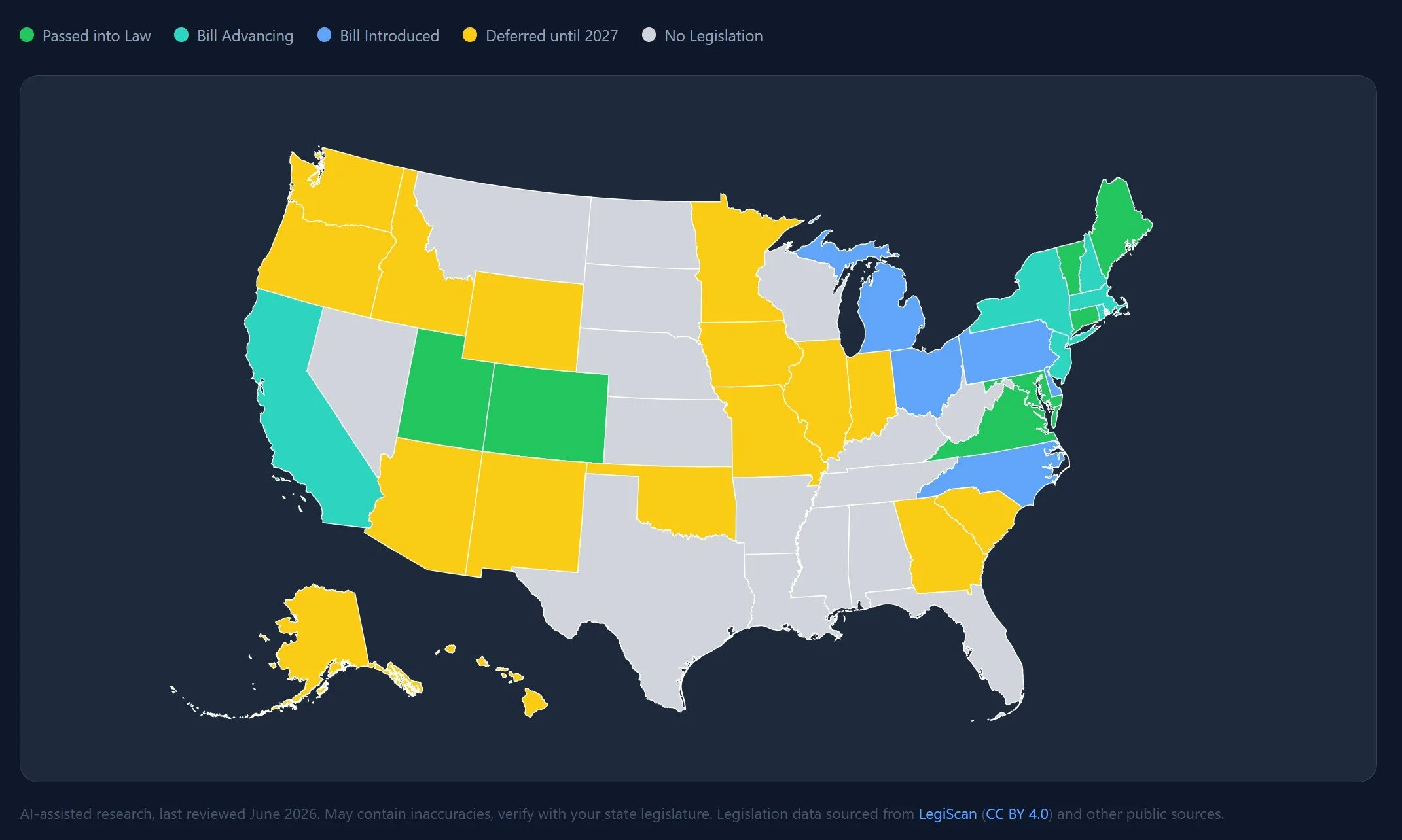
States with Plug In Solar Legislation
Approximately 7% of homes in the U.S. already have solar, with an average capacity of 7.2 kW. Plug in solar will likely expand the number of residential solar installations substantially. Because of the size restriction, however, the increase in total installed capacity will not be correspondingly large. It will take six maximum capacity plug in solar installations to equal one average rooftop installation.
As we all know, the solar panel market was negatively impacted by phasing out Federal tax credits at the end of 2025. Despite this, total solar electrical production surpassed coal for the first time this year. This simply indicates the positive return on investment from solar; it makes economic sense even without the Federal subsidy.
Plug in solar may be just what the solar industry needs to maintain momentum into the future. If you live in a state that has or will soon have enabling legislation, and you have an outdoor spot that receives a lot of sunshine and is not far from an outlet, you might want to consider plug in solar. You have nothing to lose but kilowatt-hours!