Daylighting from Space?
I came upon an article in Princeton Alumni Weekly about reflective satellites beaming daylight to Earth for a variety of purposes, including illuminating solar panels at night, replacing streetlights, extending growing seasons for agriculture, and extending work hours for industry.
The startup company proposing this is Reflect Orbital, and they offer “daylight on demand” to reduce global energy poverty. The company plans to offer up to 100 lux for 2 hours or 2 lux 24/7 in 2028, and up to 5,000 lux for minutes or up to 100 lux for 2 hours by 2020. If you are unsure what a lux is, I will explain below.
The article does a good job covering many concerns, especially from the point of view of an astronomer worried about the potential impact of another 50,000 satellites by 2035. The article also highlights the potential negative impact of all that extra light on the health of wildlife and humans. The article can be seen here. The Race To Save Our Dark Skies | Princeton Alumni Weekly
I won’t repeat the arguments for and against this proposed technology. Instead, I want to focus on the daylighting issues it brings up. I do so as an architect who specialized in the application of daylighting principles to a wide variety of building types throughout my career. I also taught a daylighting course at the University of Colorado College of Architecture and Planning.
When I taught daylighting, I started with a definition: illuminating interior spaces utilizing available light from the sun, clouds, the sky, and ground reflections. With this definition in mind, does Reflect Orbital offer daylighting? The source is still the sun, and it is beamed through the atmosphere, implying there will be some light contribution from the sky and any intervening clouds. Given the beam diameter on the surface of the Earth will be approximately 5 kilometers, there will also be some ground reflectance component. On this basis, Reflect Orbital is offering daylighting at night, just as the Moon has done, but with greater intensity and on demand.
I promised to revisit the lux, so here it is. The lux is a unit of illuminance and is the metric version of a footcandle (10.76 lux = 1.0 footcandles). For illustration, a full moon produces a range of 0.05 – 0.3 lux, street lighting is 10-75 lux, standard office lighting is 300-500 lux, and a bright sunny day may be 10,000-25,000 lux. The direct sun can be up to 100,000 lux.
Architects have used Daylighting to replace artificial lighting inside buildings for millennia. That is a useful strategy because the path of the sun through the sky is predictable. We design windows, skylights, shades, and other aspects of buildings based on those patterns of the sun through the sky. Using Reflect Orbital style technology to extend the daylighted hours of buildings would be intriguing. The angle of incidence of that light may be different from anything produced by Nature, and it may be different night to night, depending on which of the 50,000 satellites is beaming the reflected sunlight. As a result, beaming reflected light into buildings from satellites would be tricky and could result in problematic glare.
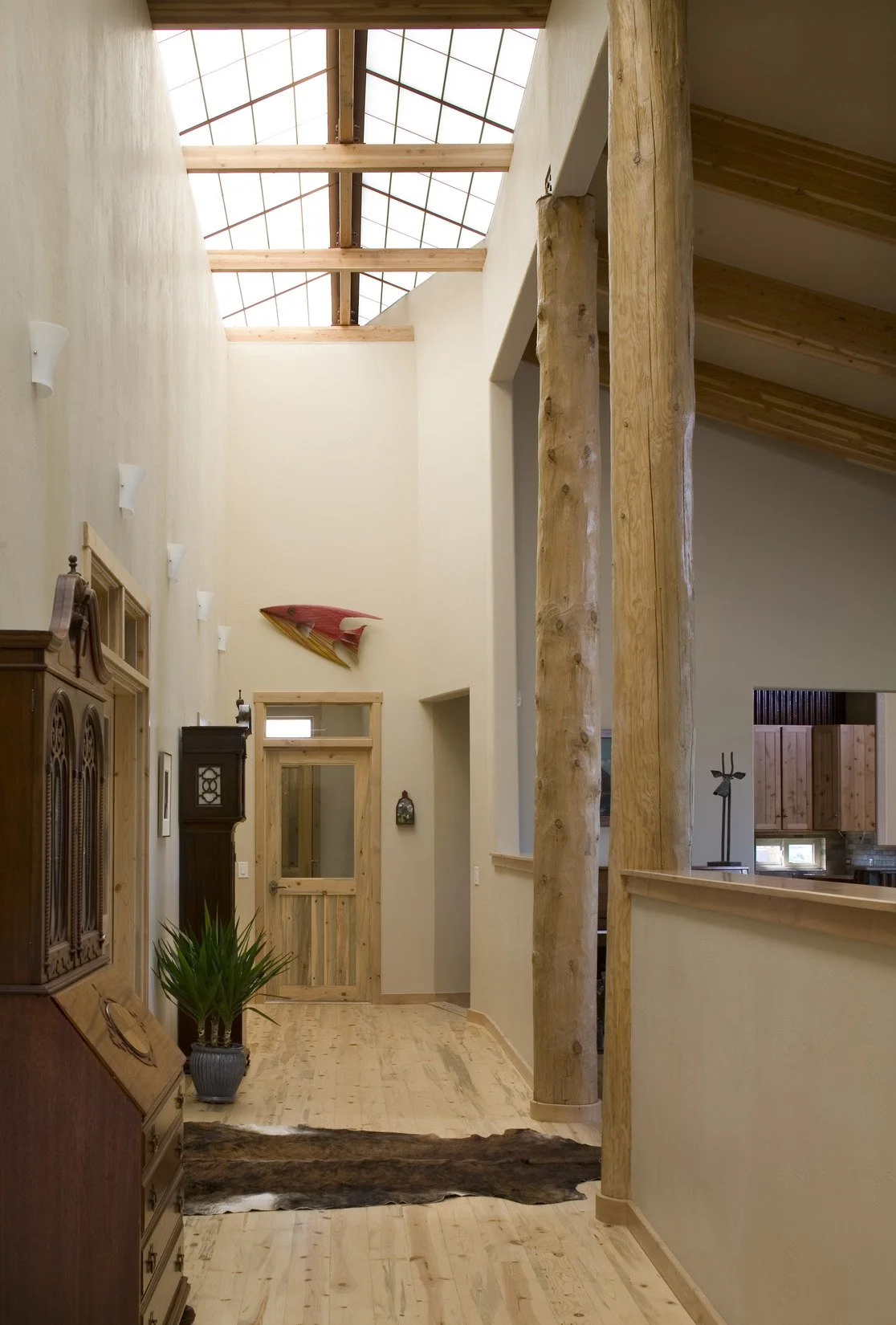
Daylighted space in my house
If you live in a daylighted house or work in a daylighted office building, and Reflect Orbital pointed one of their satellites at you at night, what would be the effect? 100 lux outside would probably result in 5 lux inside. That’s brighter than moonlight, but well below typical room illumination for a home. Even if 5,000 lux were beamed at you, inside illumination would be in the range of 200 lux, or comfortable home lighting at night. In either scenario, you might welcome that extra daylight while awake but would find it bothersome for sleeping.
I realize that Reflect Orbital doesn’t address its potential impact on building interiors, but perhaps it should. In almost any 5-kilometer diameter location (almost 20 square kilometers) there will be buildings and likely people inside them. In their scenario of providing an alternative to street lighting, most street lighting is in urban areas so the proximity to buildings is a given. Unless the re-directed light can be tuned to illuminate streets and nothing else, surrounding buildings will be impacted. Some of that illumination could be welcome but after a certain hour, it will be a nuisance.
I’d like to make one last comment about the application for Reflect Orbital I find most intriguing – illuminating large solar arrays to extend their productive hours. The benefit is that it would allow solar production to better overlap with the time of peak demand in the evening, with no extra investment in the solar array itself. Solar panel production is, however, highly dependent on the angle of incidence of sunlight. That is why many solar panels are fixed at an elevation equal to the latitude of the location. Fortunately, utility scale solar is always mounted with pivoting axes to track the sun. Those pivoting axes could be used to orient panels toward a satellite in orbit, again with no extra investment.
There is no doubt the commercialization of space will have large impacts on how we design the built environment here on planet Earth. Perhaps we will need to re-think what daylighting is.