End of the Free Ride for Driving an EV?
How should EV’s be taxed for road maintenance?
State and Federal Gas Tax
I’ve been driving hybrid vehicles for the last ten years and have owned four of them. They have been remarkably efficient and economical to operate, yet I am starting to evaluate whether it is time to make the switch to a true Electric vehicle (EV). As I write this, I am seeing much debate about the related issue of how to fairly tax owners of EV’s for their impact on roads. All gasoline sales include a large share of federal and local “gasoline tax.” In the mainland continental U.S. this varies from a low of $0.19 per gallon in New Mexico to a high of $0.71 per gallon in California. My home state of Colorado imposes a combined total tax of $0.29 per gallon.
Before I go any further, I’d like to clarify that I believe all vehicles will be electric in the future and that eventually internal combustion engine (ICE) vehicles will be either vintage or highly specialized for unusual uses.
No current tax on EV use
Owners of EV’s pay no gas tax and primarily purchase electricity from their local utility, with a few using renewable energy generated at their homes. In both cases, there is no additional fee or cost associated with road maintenance on which those heavy EV’s drive. EV drivers have been given a “free ride” compared to ICE and hybrid drivers. All roads and related infrastructure require maintenance and new investments. This is the impetus behind discussions happening in many states and even in Congress about how to implement a fair tax on EV owners.
Before delving into the thorny issue of how to best tax EV’s, we need to better understand how EV’s really compare in operating cost and environmental impact to ICE and hybrid vehicles. I find most such analyses are flawed by incomplete data or superficial analytical methods. Especially inappropriate is using gasoline costs that include road use tax while using electricity costs that have no such tax in them.
Operating Cost and Environmental Impact of ICE, Hybrid, and EV Vehicles
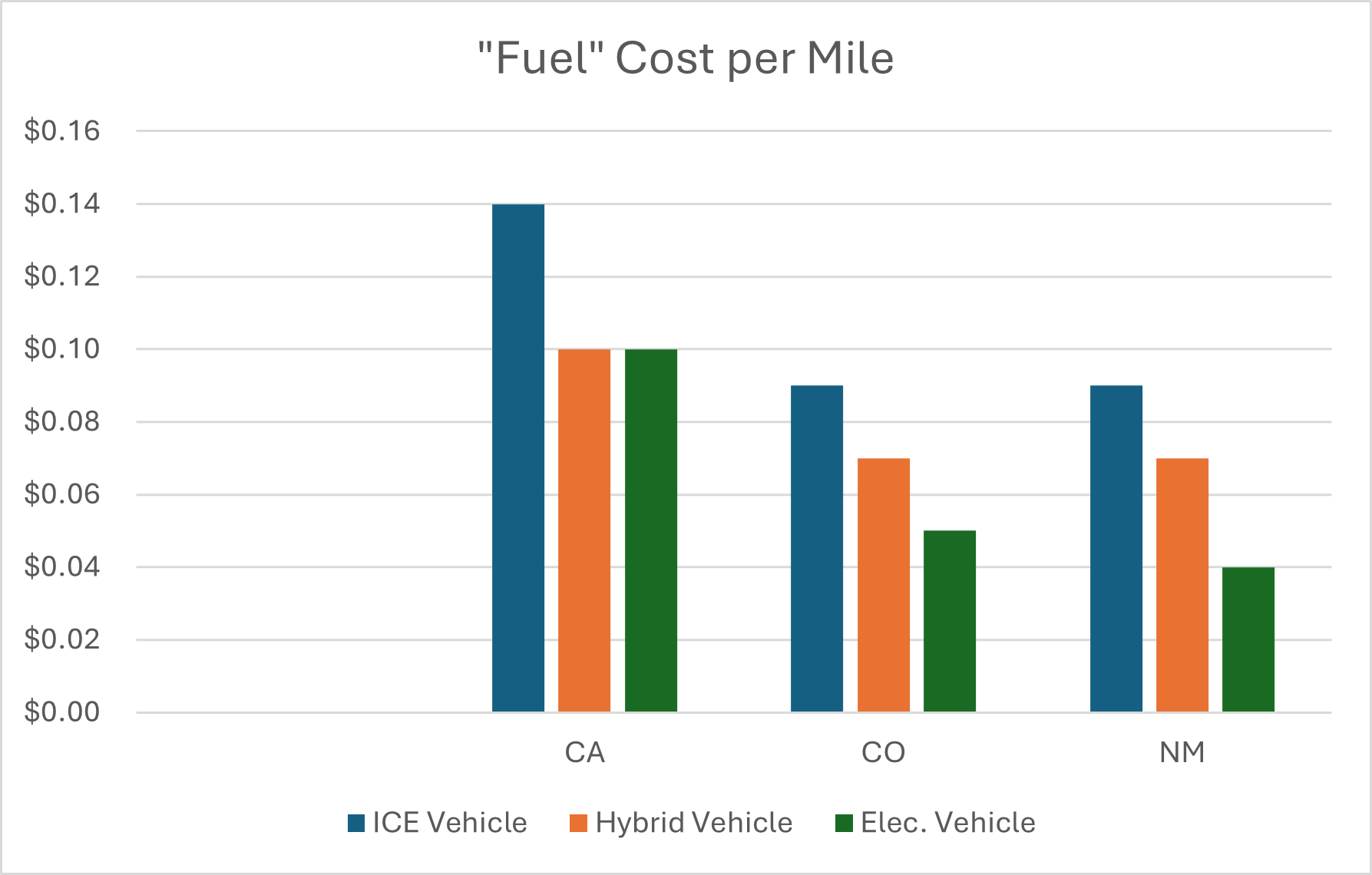
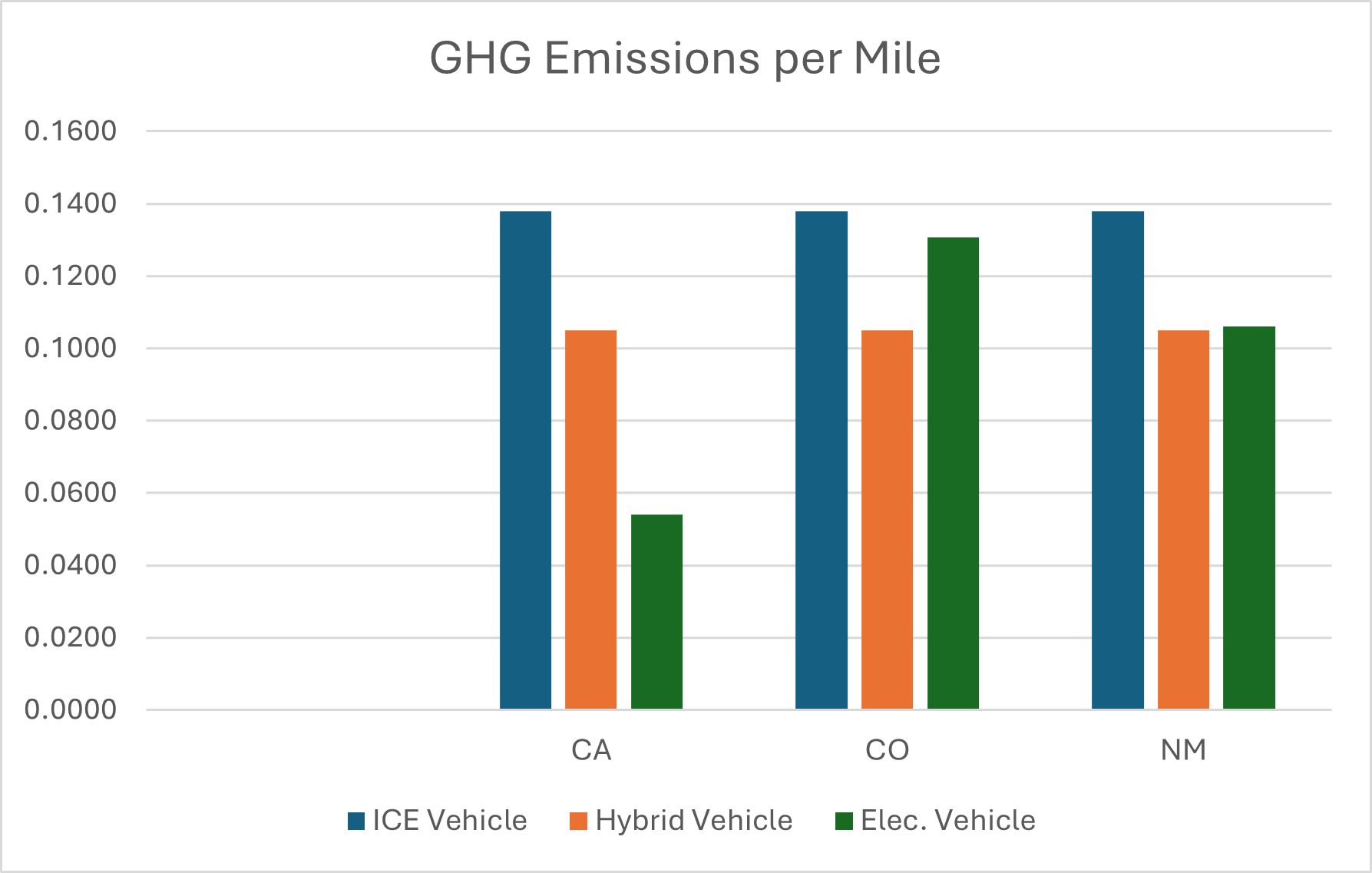
To develop this more balanced analysis, I used vehicles I am familiar with: the Honda CR-V ICE, the Honda CR-V Hybrid, and the Tesla Model Y. I have checked recent data on miles per gallon, miles per kWh, kWh prices, gasoline prices, greenhouse gas (GHG) emissions per gallon, and ghg emissions per kWh. Finally, I have run the analysis for three states: California (highest gas cost and gas tax, highest kWk cost, but lowest ghg emissions per kWh), New Mexico (low gas costs and lowest gas tax, low kWh cost, medium ghg emissions per kWh), and Colorado (low gas cost, medium gas tax, medium kWh cost, and high ghg emissions per kWh). This level of analysis is necessary because where you drive your vehicle makes a significant difference in operating cost and environmental impact. Averages are misleading!
Costs without tax complications
I have removed all federal and state gas tax from this analysis. I have done so because it is likely that soon EV owners will pay a separate road tax in some form. The current gasoline tax is a disproportionate burden on ICE and hybrid drivers. This is even more so because comparable capability EV’s are always heaver and thus impose more wear and tear on roads per mile driven. After EV road taxes are established (they will likely vary from state to state) this analysis can be run again with road taxes included across all vehicle types.
The takeaways are:
· ICE vehicles have the highest “fuel” cost per mile in all three states.
· Hybrid and EV vehicles have nearly identical “fuel” cost per mile in California, due to the very high price of gasoline there.
· EV’s have higher ghg emissions per mile in Colorado than Hybrid vehicles, and almost as much as ICE vehicles, due to the dirty grid in the central Rocky Mountain region.
· In states where electricity has less ghg emissions per kWh than Colorado, EV’s are cleaner than Hybrid and ICE vehicles.
· The fuel cost savings for a Tesla Model Y over a Honda CR-V Hybrid over 10,000 miles are $400 in California, $200 in Colorado, and $300 in New Mexico. The Tesla is approx. $10,000 more expensive.
EV Road Tax Options
With that analysis in mind, how should we best approach the question of future road taxes for EV owners? Gas taxes seem fair in that they are directly proportional to miles driven and thus impact on roads, and consumers have the choice to purchase more or less efficient vehicles. Unfortunately, gas tax may seem unfair in that there is a huge disparity from state to state, even as the federal share remains constant. How can California need a total gas tax that is 3.7 time the lowest in New Mexico? Sure, there are many more miles of road in California but there are many more drivers and miles driven to compensate for that.
There are several possible ways to levy road taxes on EV owners. A few of them are:
· Tax on electrical charging – Since more than 80% of EV charging happens at home (where there is unlikely to be separate metering), this would only capture a small amount of EV use.
· EV Manufacturer Tax – A large, one-time, tax could be levied at the time of sale for an EV, corresponding approximately to the road tax over the life of the vehicle.
· Annual EV Tax – Based on vehicle registration data, states could tax EV owners at the time of annual registration, using an average miles driven calculation.
· Vehicle Miles Traveled (VMT) Tax – If drivers were required to report miles driven annually, they could be taxed based on total annual miles. This seems fair but would be a large regulatory burden. Giver the rapid pace of technological innovation, perhaps this could be automated.
It’s too early to tell which of these, or a combination of them, will prevail. It’s also too early to tell whether traditional gas tax on ICE vehicles will remain in place or will be replaced by one of these alternate mechanisms. Whatever the future holds, we can hope for a time when all vehicle types and their owners pay an amount proportionate to the burden their vehicles impose on our road infrastructure.
So, after all this analysis, am I ready to make that EV purchase? The answer is…soon!