Shine, Baby, Shine! versus Drill, Baby, Drill!
Global renewable electrical production surpassed all other sources in 2025
I was fascinated by a brief article on AXIOS last week. It included a chart (see below) illustrating the relative percentages of renewables, coal, natural gas and oil, and nuclear in global electricity generation, from 1900 to 2025. There were two startling conclusions:
· Total renewables surpassed coal for only the second time.
· Total renewables are the single largest energy source, more than any of the other three primary sources.
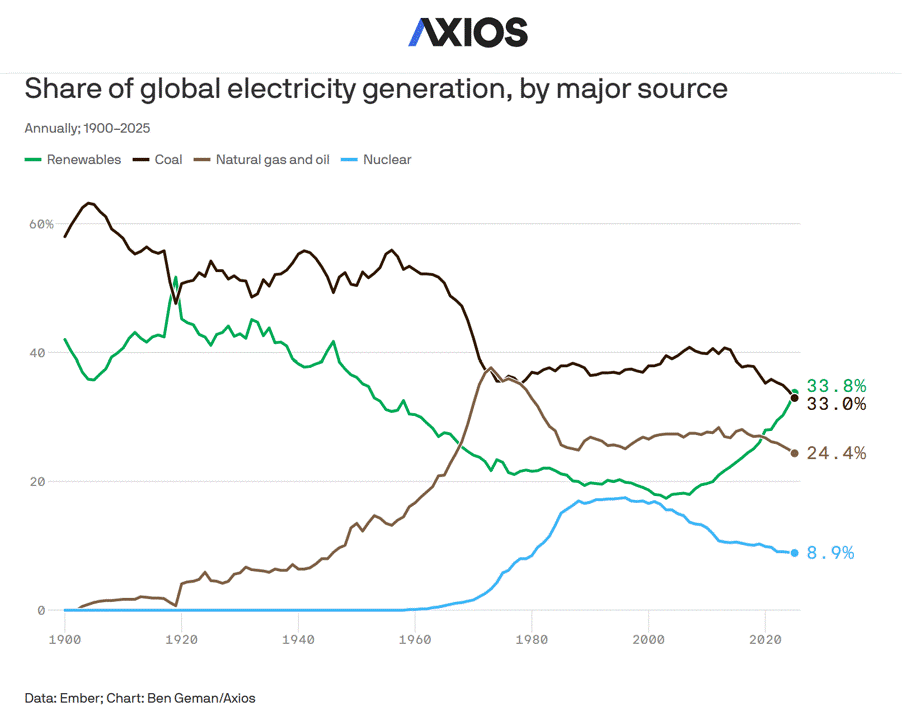
Given the current administration’s negative attitude toward both solar and wind energy, this may seem a surprising result. An easy explanation would be that the rest of the world is still developing renewables while the U.S. emphasizes fossil fuels, but that is not the case. U.S. based solar energy increased significantly in 2025, even after the new administration began implementing its policies in early 2025. Electrical capacity generating additions in 2025 were 73% solar and 18% wind in the U.S.
Let’s dig a little deeper into how the U.S. is doing compared to the rest of the world. Using recent data from the U.S. Energy Information Agency (EIA), here is a breakdown of electrical generation from February 2025 through February 2026.
Coal – 15.9%
Nuclear – 17.3%
Natural gas – 39.8%
All renewables, including non-utility solar – 26.0%.
Comparing the U.S. to global data, we are using a much lower percentage of coal, higher percentages of both natural gas and nuclear, and slightly less total renewables. Although the numbers are different, the trends are the same - market conditions are leading to the steady growth of all forms of renewable energy, while coal is rapidly decreasing, and natural gas and nuclear power are staying steady.
You might be wondering how this could be the SECOND time that renewables have passed coal as the leading source of electricity. That happened about 1920, as worldwide implementation of large scale hydroelectric increased and as oil and gas began to cut into coal’s dominance. That blip in the record was short lived, as coal continued to dominate electricity production and natural gas ramped up. Natural gas as a generator of electricity briefly passed coal in the early 1970’s but dropped back as oil markets were rocked by disruptions in the miid-1970’s. Surprisingly, all renewable electrical generation as a percentage of global generation bottomed out recently – in the early 2000’s.
As fascinating as this history is, let’s return to the central issue – how we generate electricity in the U.S. and across the world. The current administration is well known for its use of the phrase “Drill, Baby, Drill!” As a result, the U.S. has become the world’s leading supplier of fossil fuels. Maintaining reasonable prices for electricity, gasoline, and other fossil fuel products is a reasonable objective as less environmentally damaging renewable sources and infrastructure come online. The transition from fossil fuels to renewables should be well planned, financially sound, and fair to consumers and producers. But to suppose that “Drill, Baby, Drill!” Is a beneficial long-term solution to our energy needs ignores both fiscal and environmental realities.
If recent cost trends continue, solar and other renewable forms of energy will continue to out-compete fossil fuels, even without the former renewable energy subsidies. Although every form of energy production (solar and wind included) has some negative environmental impact, fossil fuel production and consumption is especially damaging. Rather than emphasizing what we can extract (drill) from planet earth, we should turn our attention to what the earth freely gives us (sunshine).

Roof of Miller Middle School, Durango, CO, image courtesy of Cuningham Architecture Group
As the Axios report implies, It is time to embrace “Shine, Baby, Shine!”