Beaver Dam Analog (BDA) Part 2
Beaver Dam Analog on Colorado Front Range Creek
Having participated in a Beaver Dam Analog build in the Black Hills two years ago, I was eager to construct one on a stretch of our creek in Colorado. One issue with our creek is that extremely high spring runoff in May 2023 washed out several existing beaver dams. Although we have seen intermittent beaver activity since that time, there has not been a new beaver dam constructed since then, and as far as we know, no beavers are active on our reach of this creek. As a result of losing those historic beaver dams and other issues, the stretch of the creek that runs through our property has experienced several problems in recent years, including:
Bank erosion
Creek bed incision
Poor floodplain connectivity
Loss of sediment deposition
Invasive plant and animal species
Working with personnel from the Colorado Parks and Wildlife (CPW) Department, River Network, Douglas County Conserves, the Chatfield Watershed Authority, and Alba Watershed Consulting, we decided where to position two BDA’s in order to address some of the problems listed above. In general, the locations are just downstream from the most severely eroded areas. By ponding water in the eroded areas, we hope to slow down the flow, raise the water table, and keep the soil damp to avoid further sloughing. The raised water table has additional benefits such as promoting more native plant growth and improving habitat for native species. BDA’s also provide excellent habitat for a variety of native fish and amphibians.
Our goal was to use all natural materials, most of which were already present in the riparian corridor. A material list is:
6 foot long, 2” diameter, wood posts, with one sharpened end
Live willow cuttings – 2-4 feet long
Old beaver cut logs, various sizes
Shovel cut clumps of grass and sedge, with roots intact
Rocks and stones, various sizes
Creek bed gravel
Tools we needed were:
Gas powered post driver, for the posts
Pruning shears and branch loppers
Long handle shovels
And don’t forget waterproof high boots and work gloves; building a BDA means spending a lot of time in the water!
Two of us spent two full days and were able to complete both dams working together. Each dam is 12 to 14 feet wide, and they are holding slightly more than one foot of water. With the grade of our creek, that backs water up approximately 100 feet up-creek and widens the creek surface slightly.
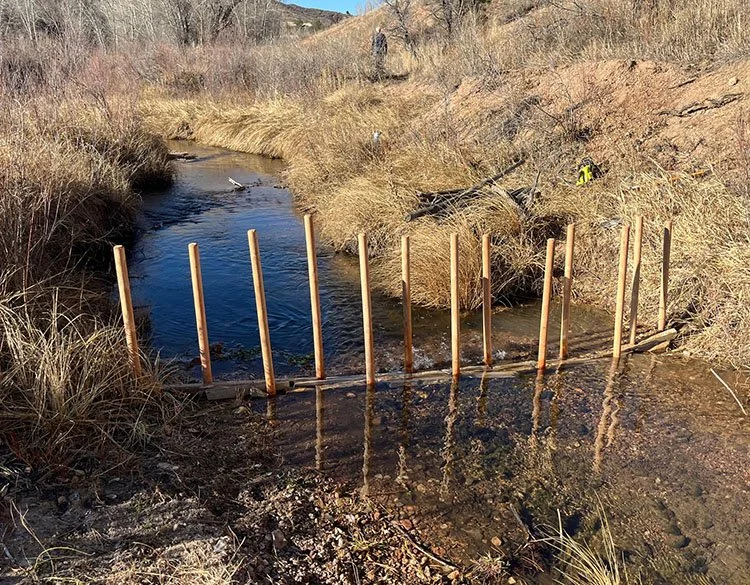
BDA early in construction process – vertical posts are set and logs are on creek bed
Every BDA is different depending on the characteristics of the creek, the amount of flow, and available materials. Our habitat is typical of the Colorado Front Range, meaning we have somewhat limited trees and are reluctant to cut branches. We therefore constructed our BDA in the following manner.
Measure creek bed width and lay out posts approx. one foot apart in two staggered rows
Set posts at least three feet into creek bed using post driver
Set some larger rocks around base of posts
Weave cut willow branches around posts and compact into bed
Cut many clumps of bank grass with roots and set on top of branches
Compact by stomping
Lay beaver cut sticks perpendicular to stream flow in both directions, embed points into creek bed
Weave another layer of cut willow branches
Cut more clumps of grass, lay on top of dam and compact again
Repeat process two or three times until desired height is attained
We are pleased to report that our BDA’s have been in place for a few months and are still working well. We’ll monitor their performance in controlling erosion as we approach the spring runoff season.
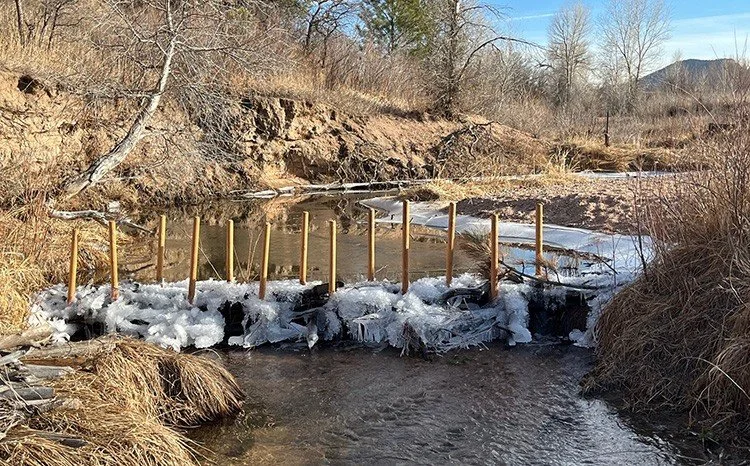
Beaver Dam Analog in winter